Inner OS
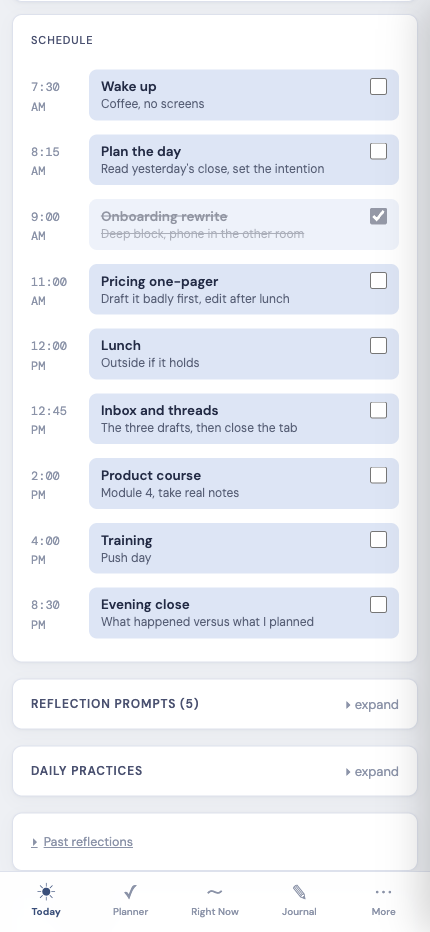
The app I open first thing. It turns scattered priorities into one visible plan for the day, then runs a short reflection pass at night on what actually happened versus what I planned.
My role and the decisions
I designed and built it. The problem it solves is a boring one, which is that I would decide something mattered and then lose it by Wednesday. Writing it down was never the issue. Seeing it again on the right day was. So the app is built around one loop, plan in the morning and look back at night, and almost everything else got cut to protect that loop.
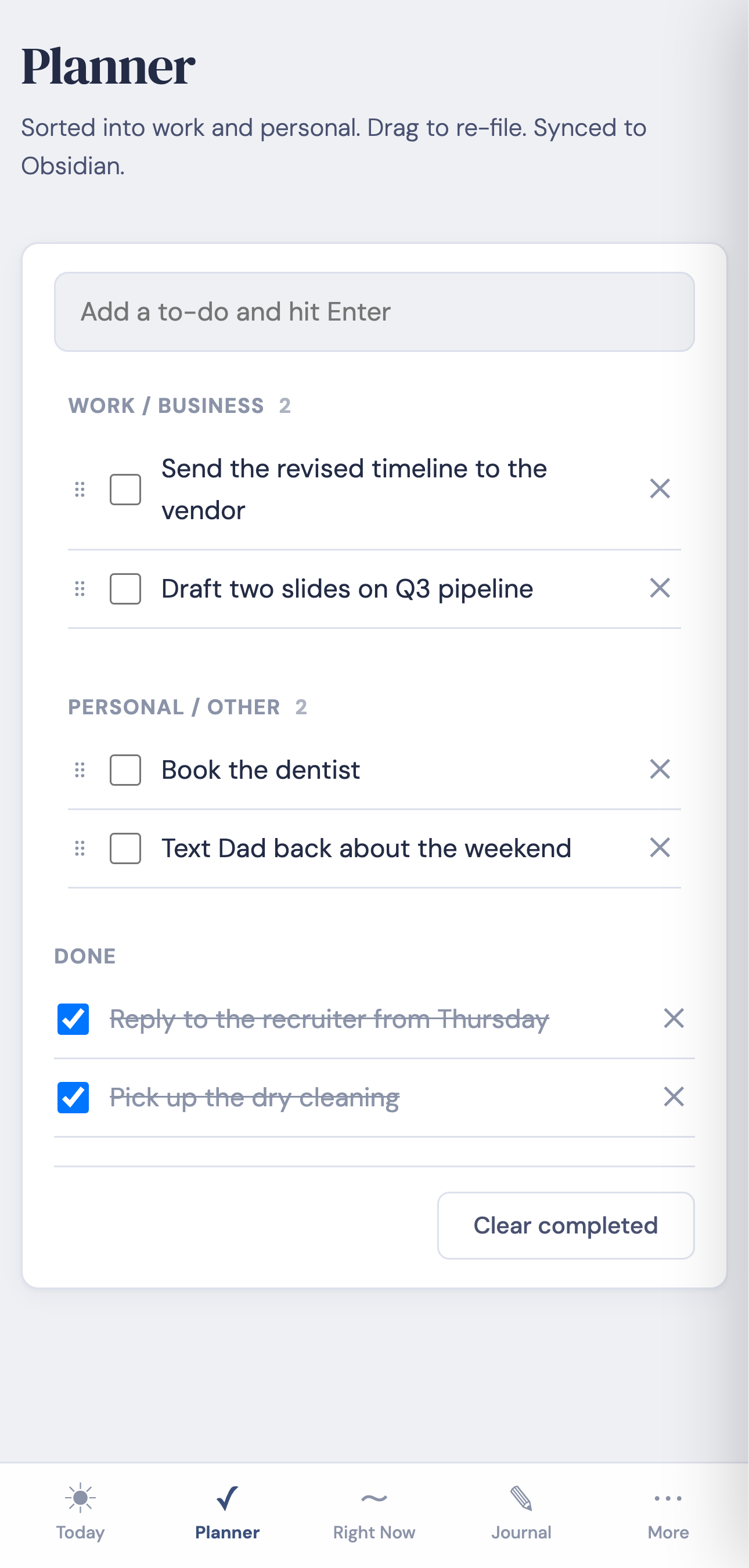
The decision that made it stick was letting capture be sloppy. I type a to-do as a fragment, the way I'd say it out loud, and it lands unsorted. A moment later something reads it, decides whether it's work or the rest of my life, and files it in the right place. Nothing about that is impressive on its own. It matters because the alternative, choosing a category at the moment I'm trying to get a thought out of my head, is exactly the friction that kills this kind of tool. The cost of capture has to be near zero or it doesn't happen at all.
It's deliberately local. The data sits in a single file on my own machine, and the browser holds a cache that is only ever a convenience, never the record. That means backing the whole thing up is copying one file. It also means there's no login, which is a real constraint rather than an oversight, and the rule I wrote down for myself is that this doesn't get a public URL until it has real auth in front of it.
The last decision was about tone. It reads like a notebook rather than a dashboard, because a tool you open in a quiet moment shouldn't be competing for your attention. No streak-shaming, no red badges, nothing urgent unless something genuinely is. The judgment it does apply happens quietly in the background rather than announcing itself.
What shipped
A local app with a planner, a place to write, and a nightly close. To-dos go in as fragments and sort themselves into work and the rest of my life, and they show up in my notes app too, so the list is the same list wherever I happen to be looking. Everything is one file on my own machine, which makes backing it up a copy command.
Outcome
It's the first thing I open most mornings, which is the only measure I trust for something with one user. The parts I'd stand behind are the near-zero cost of capture and the choice to keep the data in one file I own. Both made the app smaller and more likely to survive.